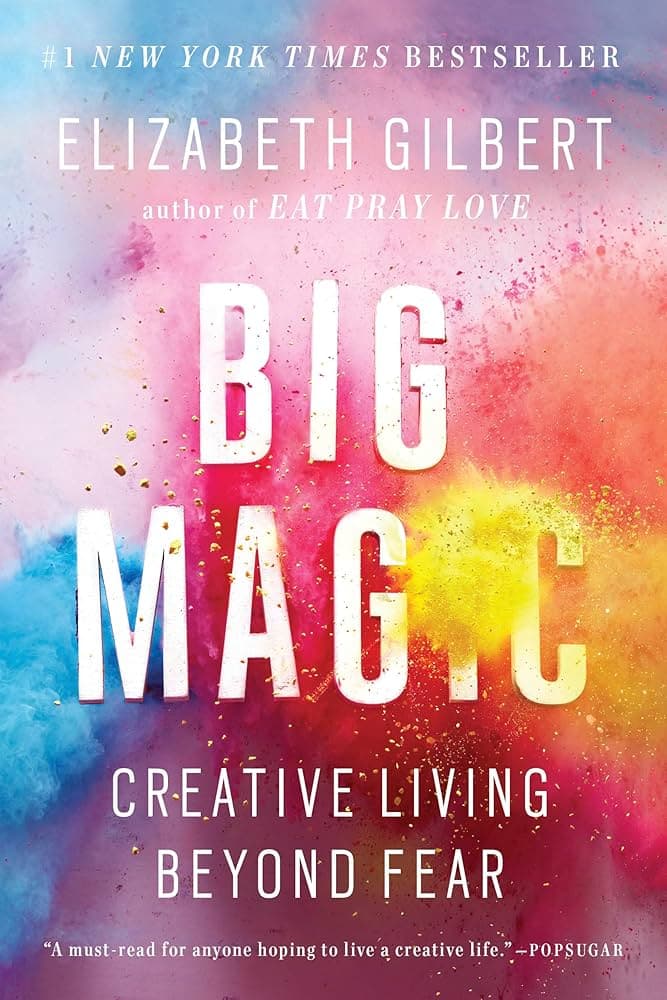
Big Magic
When I felt stuck and missed a creative spark, I picked the book up again, read it more carefully, and wrote this summary.
I read Big Magic a few years ago, but I barely remembered more than that it was inspiring—just a beautiful memory at the back of my mind (along with an unforgettable cover). When I felt stuck and missed a creative spark, I decided to pick it up again, read it more thoroughly, and write this summary.
The book is in six parts. Each part is split into short pieces, almost like blog posts, where Elizabeth Gilbert shares experiences and reflections on creativity and writing. Here are each part and the highlights I noted.
Courage
This section is about courage—and fear. My favourite moment is where the author describes fear as a figure that lives side by side with creativity. They even shared a womb, she writes—vivid and precise. They were born at the same time and even share vital organs. You cannot separate them. If you try, you often lose creativity too. So how do we learn to live with fear?
Gilbert suggests treating fear as someone in the back seat on a road trip with you and creativity. She writes a letter to fear: creativity and I are going on a road trip, and she knows fear always comes along. Fear does a great job—but creativity and I make the decisions. Fear may join, but it does not get to steer—or even choose the radio.
I like how she turns feelings into characters. Thinking of fear this way softens it a little. Running from fear or pretending it is not there does not help. You acknowledge it, but you do not let it run the show; you can steer attention toward lighter, more productive parts of your mind.
Enchantment
This chapter is about what the title hints at—that creativity can feel magical. Everyone who has made something knows the feeling of touching something that was not there before; we do not know where it came from. The maker is as surprised as the audience. Even if we trust science, something in us likes creativity because it connects us to what we cannot fully explain.
According to the author, it is about trying, searching, showing up, again and again. One random morning you might bloom. Make things to make things—to search for that feeling.
Marked quotes:
«I don’t even know where that came from.»
«It felt as if you were being guided.»
«I don’t think there is a more perfect happiness to be found in life than this state, except perhaps falling in love.»
Many may have given up on creativity because they did not frame it with love. The author stresses that the maker should create to delight themselves, not only an audience:
«Creativity is a gift to the creator, not just a gift to the audience.»
«Just write anything and put it out there with reckless abandon.»
She balances paradoxes: creativity can feel magical, ideas may have their own life—and still the process can be demystified. Creativity is not mechanical; it is something elusive we may meet more often with love and curiosity:
«It will come and go, and you must let it come and go.»
Permission
This part treats creativity as practical too:
«He didn’t quit his day job to follow his dream; he just folded his dream into his everyday life.»
It is about finding what you want to say and giving yourself permission to take space:
«Attempts at originality can often feel forced and precious, but authenticity has quiet resonance that never fails to stir me.»
Even if creativity feels mystical, it starts with permission to make something—even if it is neither original nor important:
«Your art doesn’t have to be original, in other words; it also doesn’t have to be important.»
She contrasts with advice to “help” the reader:
«Please don’t try to help me.» «I would so much rather that you wrote a book in order to entertain yourself than to help me.»
When the writer has fun and stays curious, the reader often meets that same energy. One of the best lines:
«I did not write this book for you; I wrote it for me.»
«You already know so much more than you think you know.»
«We need you to reveal to us what you know, what you have learned, what you have seen and felt.» «Just keep doing your thing.»
She writes about Eat Pray Love—she did not set out to write her greatest work; she wrote because she needed to, and was curious whether she could put the experience on paper.
«In the end, it really doesn’t matter that much. Because, in the end, it’s just creativity.»
She quotes John Lennon on the Beatles: «We were just a band!»
Human artistic expression is «blessedly, refreshingly nonessential».
And Tom Waits:
«I realized that, as a songwriter, the only thing I really do is make jewelry for the inside of other people’s minds».
Persistence
This chapter is about making room for creativity in everyday life.
«Some of the best novels you’ve ever read were written in an hour a day.»
«Frustration is not an interruption of your process; frustration is the process.»
That makes me smile. I often think creativity should feel easy; if not, I must be wrong. But frustration may be something to live with and play with.
On time: «People don’t do this kind of thing because they have all kinds of extra time and energy for it; they do this kind of thing because their creativity matters to them enough that they are willing to make all kinds of extra sacrifices for it.»
«Creative living is always possible.»
«Stop treating your creativity like it’s a tired, old, unhappy marriage (a grind, a drag) and start regarding it with the fresh eyes of a passionate lover.» «Even if you have only fifteen minutes a day in a stairwell alone with your creativity, take it.»
On perfectionism:
«I think perfectionism is just a high-end, haute couture version of fear. Perfectionism is just fear in fancy shoes and a mink coat, pretending to be elegant when actually it’s just terrified.»
And on the effort of searching:
«The effort is worth it, because when at last you do connect, it is an otherworldly delight of the highest order…»
Trust
This part is about trust—harder, and less fun, to create if you do not believe you belong or are allowed to take space. The author contrasts the martyr, harsh with themselves, with the trickster—curiosity, experimentation, fun:
«Curiosity is what keeps you working steadily, while hotter emotions may come and go.»
She tells of filmmaker Mike Nichols studying what did not work and thinking: «How interesting that the scene did not work…»—a distanced curiosity rather than shame.
Divinity
The last chapter tells how Balinese dancers created a tourist version of sacred dance—yet the new choreography became so interesting that priests wanted to fold parts back into the temple ritual. They «stumbled upon the divine» by trying to entertain—even when aiming for the opposite. Creativity can happen anywhere, when you least expect it.
That is the arc of this warm, motivating book—full of paradoxes and an honest picture of creativity, from mystical to practical, frustrating, and sometimes necessary, natural, and human.